
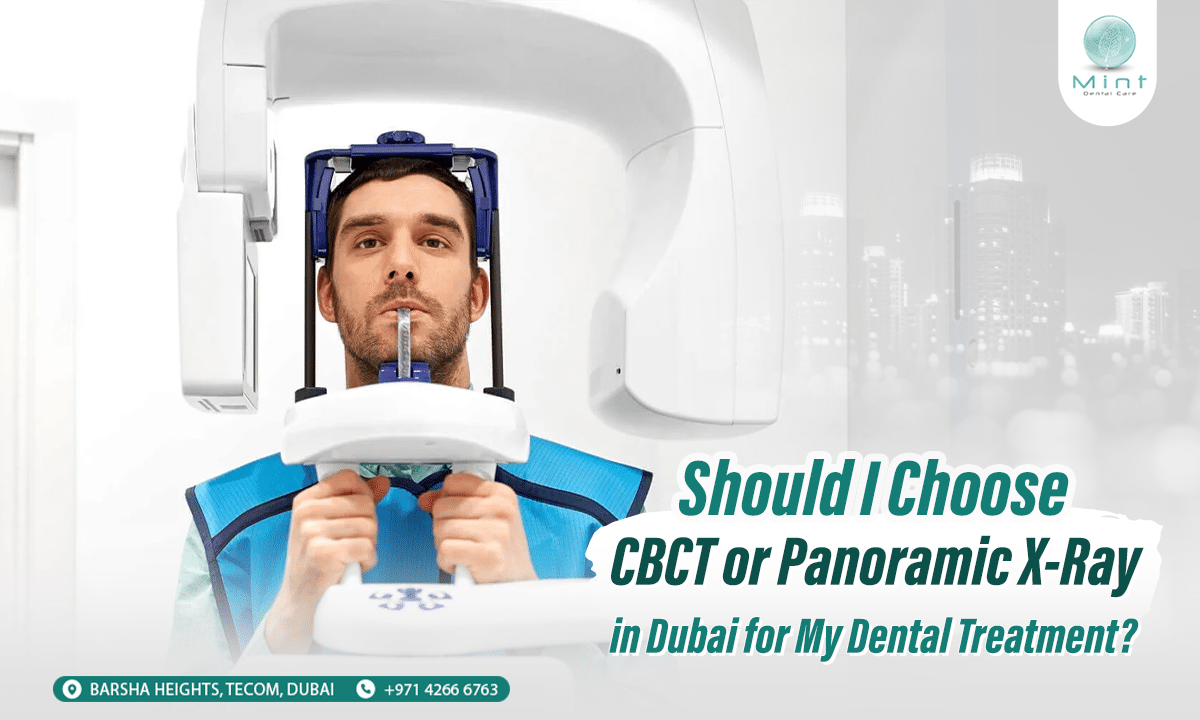
Choosing the right type of dental imaging is one of the most important steps in ensuring safe, accurate, and effective treatment. In modern dentistry, two of the most common imaging techniques are CBCT (Cone Beam Computed Tomography) and panoramic X-rays. Both play a vital role in diagnosis and treatment planning, but they serve different purposes and levels of detail.
In Dubai, where dental clinics are equipped with state-of-the-art technology, understanding the difference between CBCT and panoramic imaging can help you make an informed choice. At Mint Dental Care, we use both modalities as part of our commitment to precision dentistry. Whether you’re planning a dental implant, root canal, orthodontic treatment, or wisdom tooth extraction, the right scan ensures a smooth, predictable outcome.
Understanding Panoramic X-Rays
A panoramic X-ray is a two-dimensional (2D) dental image that captures your entire mouth in a single scan — including all teeth, upper and lower jaws, sinuses, and jaw joints. It provides a broad overview of oral structures and is an essential tool for routine examinations, orthodontic assessments, and general treatment planning.
Panoramic X-rays are often used in the early stages of diagnosis. They allow the dentist to evaluate tooth positioning, detect cavities, identify bone levels, and spot hidden issues like impacted teeth or cysts. Because the radiation dose is very low and the procedure is quick, panoramic X-rays are ideal for regular check-ups and pre-treatment evaluation.
At Mint Dental Care, we use digital panoramic X-ray systems that provide crystal-clear, high-resolution images with minimal exposure. The scan typically takes less than 20 seconds and is completely painless. The resulting image helps our dentists identify potential concerns and plan your treatment accurately and safely.
However, panoramic X-rays have certain limitations. Because they are 2D images, they do not show fine details of bone thickness, nerve positioning, or the internal structure of roots — aspects that are critical for complex or surgical dental procedures. This is where CBCT technology becomes invaluable.
What Is CBCT (Cone Beam CT)?
CBCT stands for Cone Beam Computed Tomography, an advanced 3D imaging technique that provides a highly detailed, three-dimensional view of your teeth, jawbones, nerves, and surrounding structures. Unlike a traditional CT scan, which is used in hospitals, dental CBCT is specifically designed for oral and maxillofacial imaging.
The scanner rotates around your head in a single motion, capturing hundreds of images that are reconstructed into a precise 3D model. This allows our dentists to evaluate depth, volume, and relationships between bone, nerves, and teeth with exceptional accuracy.
At Mint Dental Care, we use low-dose CBCT scanners equipped with advanced software that minimizes radiation exposure while maximizing image clarity. The process is quick (typically under a minute), comfortable, and essential for many advanced dental treatments, including implant placement, orthodontics, root canal therapy, oral surgery, and TMJ assessments.
Because CBCT captures fine anatomical details, it helps prevent complications, reduces surgical risks, and improves treatment success rates. The result is safer, more predictable, and more personalized dental care.
CBCT vs. Panoramic X-Ray: Key Differences
| Feature | Panoramic X-Ray | CBCT (Cone Beam CT) |
| Image Type | 2D (flat image) | 3D (volumetric image) |
| Coverage | Full mouth overview | Detailed area of interest |
| Detail Level | Basic bone and tooth structure | Microscopic detail of bone, roots, and nerves |
| Radiation Dose | Low | Slightly higher (still minimal) |
| Use Cases | Check-ups, orthodontics, general exams | Implants, surgeries, endodontics, complex cases |
| Time Required | ~20 seconds | 30–60 seconds |
| Precision for Planning | Moderate | High, ideal for surgical and restorative planning |
In simple terms, panoramic X-rays are like a “map” of your entire mouth, while CBCT scans are like a “3D model.” When your dentist needs to understand not just where structures are but how they relate to each other in three dimensions, CBCT becomes the superior choice.
When to Choose Panoramic X-Ray
A panoramic X-ray is usually recommended for:
- Routine dental examinations and annual check-ups
- Orthodontic assessments before braces or aligners
- Wisdom teeth evaluation
- General jaw alignment and sinus overview
- Screening for cysts, infections, or developmental abnormalities
This imaging method is fast, comfortable, and sufficient for most preventive or basic dental care needs. Because of its low exposure and broad coverage, it’s often the first step before any advanced imaging is ordered.
At Mint Dental Care, our dentists use panoramic scans to build an initial overview of your oral health. If the results reveal deeper issues or if surgical precision is needed, we may then recommend a CBCT scan for further evaluation.
When to Choose CBCT
A CBCT scan is recommended for cases that require precise anatomical mapping, especially when depth, volume, or bone quality must be measured. Common indications include:
- Dental Implants: To assess bone density, thickness, and nerve positioning before implant placement.
- Root Canal Treatment: To locate hidden canals, fractures, or lesions not visible in 2D images.
- Wisdom Tooth Surgery: To evaluate proximity to the mandibular nerve and sinus cavities.
- Orthodontics: For accurate 3D assessment of root alignment and jaw relationships.
- TMJ Disorders: To analyze joint anatomy, condyle position, and bone surfaces.
- Facial Pain or Pathology: To detect infections, cysts, and tumors.
Because CBCT imaging provides a true 3D view, it eliminates the guesswork that sometimes occurs with flat X-rays. For treatments like implants or surgical extractions, this precision is essential to avoid nerve injury or sinus complications.
Safety and Radiation Considerations
One of the most common patient concerns is radiation exposure. Both panoramic and CBCT scans use very low doses of radiation, especially with today’s digital systems. In fact, dental imaging emits significantly less radiation than a standard medical CT scan or even a long-haul flight.
At Mint Dental Care, we follow strict ALARA (As Low As Reasonably Achievable) protocols to ensure patient safety. Our digital imaging units are calibrated for minimal exposure without compromising detail. Additionally, we use protective lead aprons and thyroid collars for extra safety, particularly for children and pregnant women.
We only recommend CBCT scans when the benefits clearly outweigh the exposure — for example, in surgical or implant cases where 3D information is critical for accuracy and safety.
The Role of Advanced Imaging in Precision Dentistry
In modern dentistry, precision is everything. CBCT imaging has transformed diagnosis and planning, allowing treatments to be more conservative, accurate, and predictable. When we can visualize bone contours, nerve positions, and root angles in 3D, we reduce surgical time, improve outcomes, and minimize post-treatment discomfort.
At Mint Dental Care, digital imaging is integrated into every major procedure. Our dentists use CBCT and panoramic scans for comprehensive analysis, and we overlay the data with digital impressions when planning restorations, implants, or orthodontic treatments. This digital ecosystem ensures that every patient receives individualized, high-quality care based on accurate data rather than assumptions.
CBCT and Panoramic Imaging at Mint Dental Care
Our clinic is equipped with next-generation digital scanners that produce high-resolution images with minimal radiation. Here’s what makes our imaging process exceptional:
- Comfortable Experience: Standing or seated scanning positions with no discomfort or enclosed chambers.
- Quick Turnaround: Scans take less than a minute, and results are available instantly for review.
- Precision Planning: Our dentists analyze the scans using advanced software for implant and surgical guides.
- Data Integration: We combine CBCT data with intraoral scans and photos for 3D smile design and treatment simulation.
- Patient Transparency: You’ll see your own scan and understand your treatment plan visually — clear, educational, and interactive.
Whether you’re coming in for a simple check-up, orthodontic consultation, or implant planning, our technology ensures your diagnosis is complete, accurate, and personalized.
Frequently Asked Questions
Is CBCT better than a panoramic X-ray?
Not necessarily better — just more detailed. CBCT provides 3D images for complex cases, while panoramic X-rays are perfect for general assessment. The best choice depends on your treatment needs.
Does CBCT expose me to high radiation?
No. Modern CBCT scanners use extremely low radiation doses — often equivalent to just a few days of natural background exposure.
How long does a CBCT scan take?
Typically between 30 and 60 seconds, depending on the field of view. The entire process, including preparation, usually takes under 10 minutes.
Can I get both scans at the same clinic?
Yes. Mint Dental Care offers both panoramic and CBCT imaging in one location, allowing seamless diagnosis and treatment planning without external referrals.
Is CBCT required for dental implants?
Yes, for most implant cases. It ensures safe placement by showing exact bone dimensions and nerve pathways.
Why Dubai Patients Trust Mint Dental Care for Dental Imaging
Mint Dental Care has become a leading name in digital dentistry and advanced diagnostics in Dubai because we blend innovation with patient care. Our imaging technology ensures accuracy, safety, and efficiency, while our team takes time to explain every detail of your results. Patients trust us because we:
- Use low-radiation, high-resolution imaging systems
- Integrate CBCT and panoramic data into all treatment plans
- Offer precise 3D implant and orthodontic planning
- Maintain a comfortable and transparent patient experience
- Focus on safety, efficiency, and long-term oral health outcomes
Final Thoughts
If you’re asking, “Should I choose CBCT or panoramic X-ray in Dubai for my dental treatment?” — the answer depends on your needs. For routine check-ups and broad evaluations, panoramic X-rays are ideal. But for complex, surgical, or implant-related treatments, CBCT provides unmatched precision and safety.
At Mint Dental Care, we believe that accurate diagnosis is the foundation of successful treatment. By offering both CBCT and panoramic imaging under one roof, we give every patient the advantage of customized, data-driven dental care. Whether you’re planning a smile makeover, dental implant, or root canal, you can trust that your treatment will be guided by the most advanced imaging technology available in Dubai.
Book your dental imaging consultation at Mint Dental Care today to discover how precision technology can make your next dental treatment safer, faster, and more predictable.