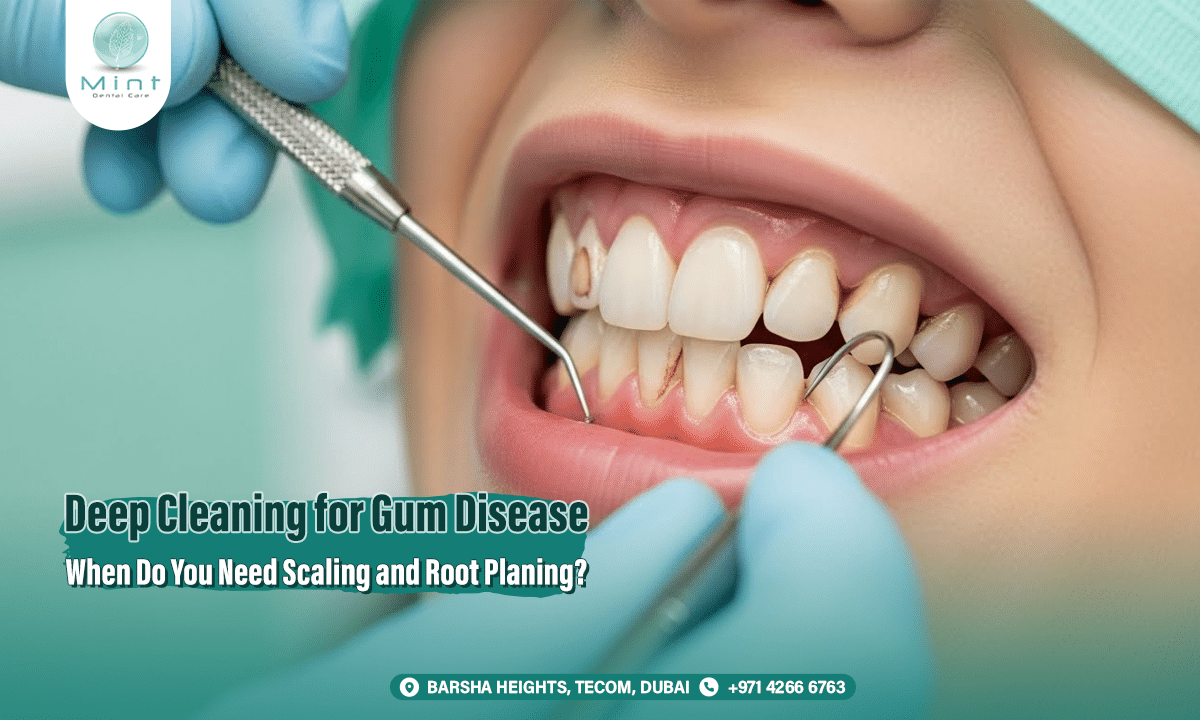
Maintaining good oral hygiene shields your gums from scaling and root planing, which is used to treat oral bacteria, in addition to preventing cavities in your teeth. Gum disease and periodontal disease are more prevalent in individuals who do not practice good oral hygiene.
Professional deep cleaning procedures can effectively cure gum disease in its early stages.
Scaling and root planing
Professionally referred to as scaling and root planing (SRP), deep cleaning gum disease is anon non-surgical periodontal therapy process that smoothes the tooth roots and removes accumulated plaque and tartar from both above and below the gum line. The main strategy for treating moderate to severe gum disease (periodontitis) and stopping further harm or tooth loss is this therapy.
What are root planing and scaling?
Dentists refer to a thorough dental cleaning as scaling and root planing. It’s similar to a standard dental cleaning, but it goes more under your gums.
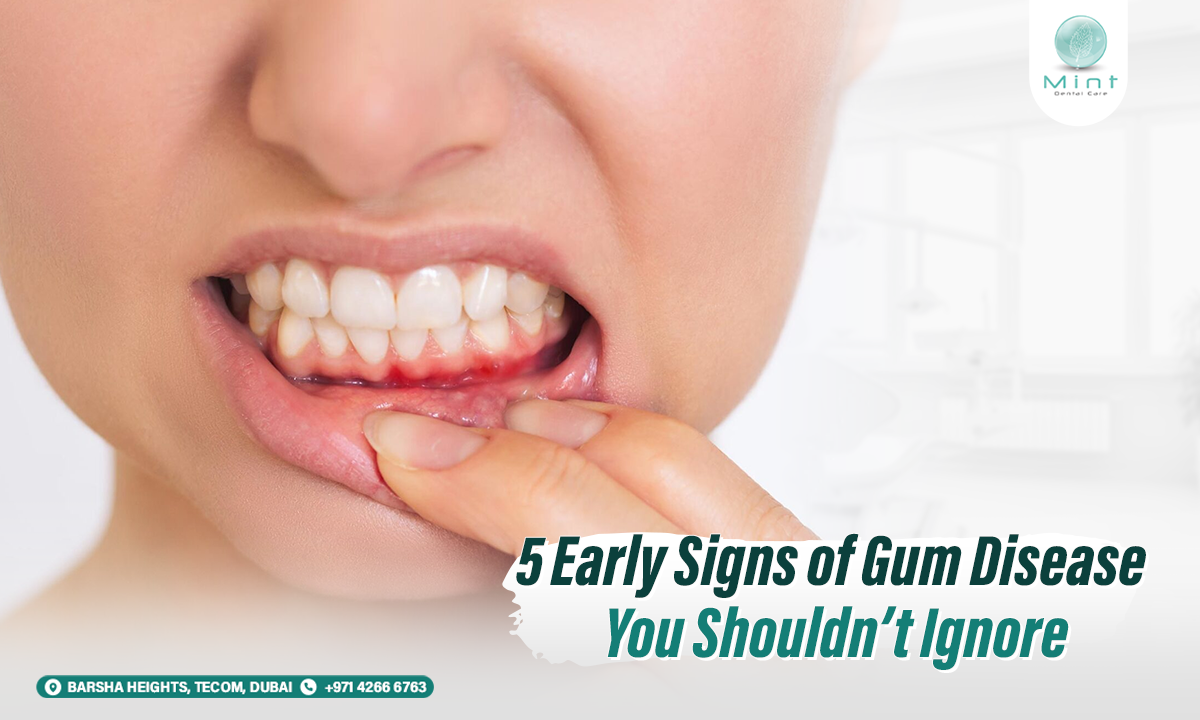
If you have periodontitis, you may require a thorough dental cleaning. Bleeding gums treatment or swelling are signs you need deep cleaning for periodontitis.
Plaque and tartar above the gum line are removed via tooth scaling. Root planing eliminates tartar and plaque beneath the gum line and smoothes the roots of your teeth. When combined, tooth scaling and root planing can eliminate microorganisms that cause illness and enhance your general oral health.
The following medical professionals are capable of thoroughly cleaning your teeth:
- Dental hygienists
- Dentists
- Periodontists
Root planing and scaling are nonsurgical procedures. For mild to severe gum disease, this is typically the initial course of therapy.
Periodontal Disease Symptoms
Gum disease, also known as periodontal disease, is an oral bacterial infection that affects the gums.
Tooth decay and cavities are also brought on by the same mouth bacteria. In addition to a host of additional symptoms, such as sensitivity, redness, bleeding, and foul breath, the bacterial infection causes inflammation. Mouthwash and brushing do not eliminate periodontal disease symptoms.
Periodontal disease has three stages:
- Gingivitis
Mild inflammation, pain, and bleeding after brushing or flossing are typical signs at this early stage of gum disease.
- Periodontal disease
The ligaments and tissues that cooperate with your jawbone to create an anchor system for your teeth begin to deteriorate in the second stage of gum disease. In order to reverse the illness and the symptoms, professional care is usually needed at this point as the symptoms worsen. If treatment is not received, pockets start to form between the teeth and the gums, making it challenging to eradicate the oral germs using mouthwash or brushing.
- Progression of Periodontitis
Infectious microorganisms have attacked the ligaments that support your teeth in the jawbone during the third and final stage.
What takes place throughout the scaling and root planing process
- Anesthesia: To reduce pain and numb the gums, a local anesthetic is commonly utilized.
- Scaling: Plaque and hardened tartar are removed from the tooth surfaces above and below the gum line by a dentist or dental hygienist using specialized instruments (manual or ultrasonic scalers).
- Root Planing: The teeth’s roots are meticulously polished. Gum tissue can repair and reconnect to the tooth as a result of the removal of any bacteria-harboring deposits and the creation of a clean surface.
- Post-procedure irrigation: The region may be cleaned with an antibacterial rinse.
Why It’s Required
When gum disease has advanced past the early stages (gingivitis), a thorough cleaning is advised. The gums become irritated and separate from the teeth due to untreated plaque and tartar, creating “pockets” where further germs can grow. The process aids in:
- Stop the gum disease from becoming worse.
- Encourage the gums to recover and connect to the teeth.
- Minimize bleeding, irritation, and chronic foul breath.
- Prevent tooth loss or loose teeth by preventing harm to the supporting bone structure.
The Process: Root Planning and Scaling
Usually carried out over the course of one or two dental appointments, this thorough cleaning frequently uses a local anesthetic to numb the gums.
- Scaling: The dentist removes all plaque, germs, and hardened tartar (calculus) from the tooth surfaces and deep inside the periodontal pockets using specialized tools (manual or ultrasonic).
- Root Planing: Next, the teeth’s roots are smoothed. This helps the gums firmly reconnect to the healthy, smooth root surface by removing uneven areas where germs may readily congregate again, discouraging further accumulation.
Recuperation and Aftercare
Following the scaling and root planing surgery, some soreness, tenderness, swelling, or tooth sensitivity is typical and normally goes away in a few days to a week. Specific aftercare advice, such as avoiding crunchy, spicy, or excessively hot or cold meals during the initial recovery phase, will be given by your dentist or hygienist.
Use a toothbrush with gentle bristles and floss every day.
To promote healing and avoid infection, rinse with warm salt water or a medicated mouthwash.
Using over-the-counter medications to treat discomfort.
A follow-up consultation will be arranged to evaluate pocket depths and assess gum healing after the deep cleaning. To maintain optimal gum health and avoid recurrence, those receiving treatment for gum disease may require more regular maintenance cleanings (e.g., every three to four months instead of twice a year).
QUESTIONS THAT ARE OFTEN ASKED RELATED TO SCALING AND ROOT PLANING
What is included in thorough cleaning when we use gum disease treatment Dubai?
Scaling and root planing are the two phases of deep cleaning. While root planing entails removing plaque and tartar from your tooth’s roots, scaling removes plaque and tartar from your teeth and the spaces between them.
Depending on how serious the patient’s condition is, a deep cleaning procedure may need two or more clinic visits. The majority of the time, dentists treat one side of your mouth at a time and divide the process into portions.
Do you require a thorough cleaning?
The best person to determine if you need a thorough cleaning is your dentist. They will assess the extent of bacterial and infectious pockets that have developed between your teeth and gums and determine whether a deep cleaning is necessary.
Your dentist may recommend at-home hygiene practices and request regular dental checkups if your mouth exhibits symptoms of gum disease. However, if the patient has pockets larger than 4 or 5 mm, extensive cleaning will be advised.
If a deep cleaning is advised, it should be completed as quickly as possible to prevent the development of gum disease.
The final result
A thorough tooth cleaning by scaling and root planing might help get rid of foul breath and slow the progression if you have gum disease. It could help stop tooth loss in the future.
To finish the deep clean, some folks might require many sessions.
You may anticipate some discomfort and swelling following this routine, safe operation. Consult your dentist if discomfort, bleeding, or swelling persists for more than a week following your operation.