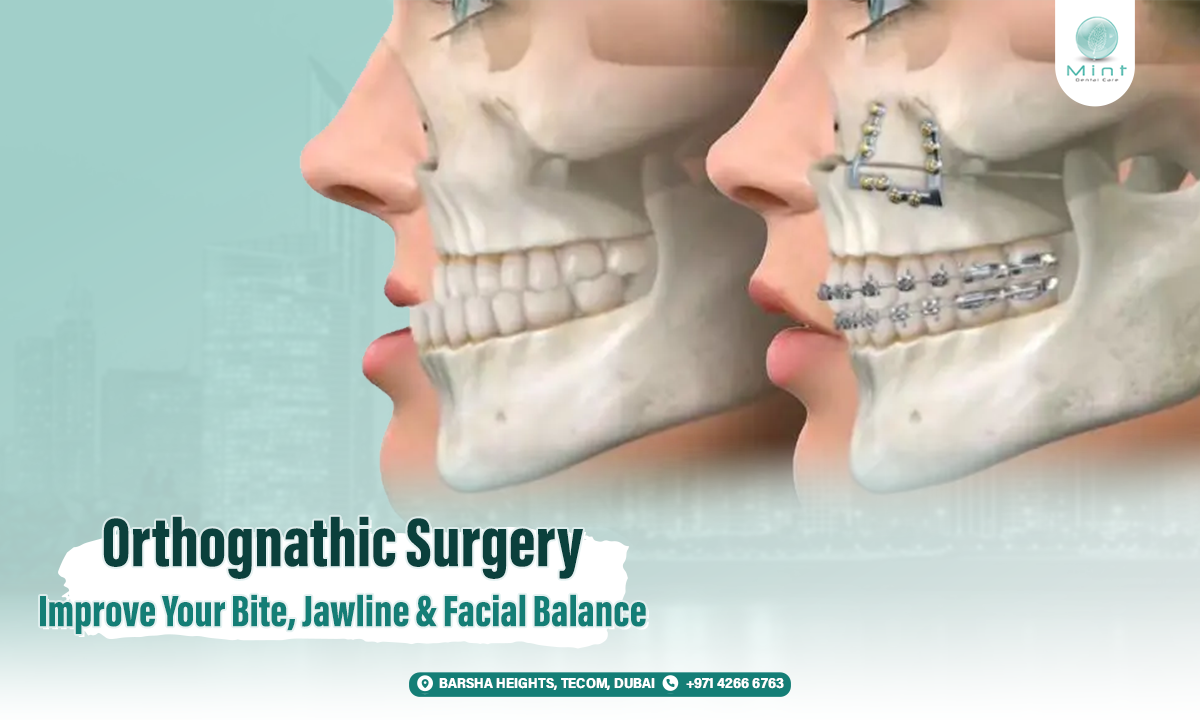
A healthy smile is not only about straight teeth. In some patients, the real problem is deeper than the teeth themselves. The upper jaw, lower jaw, or both may be out of balance, creating issues with the bite, facial proportions, chewing, speech, and sometimes even breathing. In those cases, orthodontics alone may not be enough. That is where orthognathic surgery, also called corrective jaw surgery, comes in. Mayo Clinic explains that orthognathic surgery repositions crooked or uneven jawbones, lines up the jaws and teeth so they work better, and may also make the face look more balanced.
At Mint Dental Care, many patients come in asking whether braces or clear aligners can fix everything. For mild to moderate tooth-position problems, orthodontics often works very well. But when the issue is skeletal, meaning the jawbones themselves are not in the right position, moving teeth alone may not create a healthy or stable result. Cleveland Clinic notes that braces can move teeth, but they cannot move the jaw or change its shape, while Mayo Clinic states that jaw surgery may be the corrective option when braces alone cannot fix the problem.
This is why orthognathic surgery is often discussed as both a functional and esthetic treatment. It can improve the way your teeth meet, help create a stronger or more balanced jawline, and correct facial asymmetry or disproportions that come from jaw imbalance rather than tooth misalignment alone. NHS jaw-surgery guidance gives examples of lower-jaw advancement improving jaw and chin prominence, and combined upper-and-lower-jaw surgery correcting bite problems while altering facial balance.
What Is Orthognathic Surgery?
Orthognathic surgery is a procedure performed by an oral and maxillofacial surgeon to reposition the upper jaw, lower jaw, chin, or a combination of these structures. It is used when the jaws are not aligned properly and the mismatch cannot be corrected with orthodontics alone. Cambridge University Hospitals states that upper- and lower-jaw corrective surgery is recommended when it has not been possible to correct tooth alignment with orthodontics alone, and that genioplasty may be added to change the chin profile.
In simple terms, braces and aligners move teeth within the jawbones, while jaw surgery changes the position of the jawbones themselves. That distinction is very important. If the upper and lower jaws are out of proportion, orthodontics may straighten the teeth but still leave the bite unstable or the facial profile unbalanced. Cleveland Clinic and Mayo Clinic both make this point clearly: orthodontic treatment can reposition teeth, but orthognathic surgery is the option that changes the skeletal structure of the mouth and jaws.
Who May Need Corrective Jaw Surgery?
Orthognathic surgery is usually considered when a patient has a significant skeletal bite problem. That may include a severe overbite, underbite, open bite, facial asymmetry, or a jaw that sits too far forward or too far back. The American Association of Oral and Maxillofacial Surgeons says orthognathic surgery may be indicated for major facial skeletal deformities associated with masticatory malocclusion, and in some documented cases involving airway dysfunction, TMJ-related problems, psychosocial issues, or speech impairment.
For many patients, the first signs are practical ones. They may struggle to bite food properly, feel that their teeth do not meet comfortably, notice their chin looks too prominent or too weak, or feel that one side of the face looks different from the other. NHS information for patients considering orthodontics and jaw surgery lists problems such as difficulty eating due to teeth not meeting correctly and poor facial appearance when the jaws are out of balance.
Corrective jaw surgery is generally planned after jaw growth is complete. Mayo Clinic says the best timing is usually after growth stops, commonly around ages 16 to 18 and older for females and 18 to 21 and older for males, although treatment timing still depends on the individual case.
How Orthognathic Surgery Improves Your Bite
The first and most important benefit of orthognathic surgery is function. A balanced bite allows you to chew more efficiently, speak more comfortably, and distribute pressure more evenly across your teeth and joints. Mayo Clinic states that surgery lines up the jaws and teeth to make them work better, while Cambridge University Hospitals notes that the main purpose of jaw surgery is to correct a bite that orthodontics alone cannot fix.
This matters because a poor bite is not only a cosmetic concern. When the teeth do not meet correctly, the result can be uneven wear, excessive pressure on certain teeth, difficulty eating, jaw strain, and instability that makes long-term orthodontic results harder to maintain. Cleveland Clinic explains that misaligned jaws can negatively affect the bite and make eating and speaking more difficult.
For some patients, surgery may also help in carefully selected cases involving airway concerns or jaw-joint symptoms, but that must always be assessed individually by the surgical and orthodontic team rather than assumed from a headline. AAOMS includes airway dysfunction such as sleep apnea and some TMJ-related dysfunction among documented indications in certain clinical settings.
How It Can Improve Your Jawline and Facial Balance
The second major reason patients consider orthognathic surgery is facial harmony. When one jaw is too far forward, too far back, too narrow, or shifted to one side, the whole lower face can appear out of balance. Orthognathic surgery can reposition the jaws so the facial profile looks more proportional and symmetrical. Mayo Clinic says that jaw surgery may make the face look more balanced, and NHS patient examples show lower-jaw advancement improving lower-jaw and chin prominence and dual-jaw surgery correcting asymmetry and altering facial balance.
This does not mean the surgery is just about appearance. In the best cases, function and esthetics improve together. A better bite often comes with a more harmonious facial profile because the jaws themselves are being brought into a healthier relationship. Cambridge University Hospitals also notes that genioplasty may be used to change the position or profile of the chin, often alongside jaw surgery.
Patients who want a stronger jawline, a less retruded chin, or improved symmetry should understand one key point: if the issue comes from the jawbones, tooth straightening alone usually cannot create the same effect. That is why a proper diagnosis is essential before choosing between braces alone and combined orthodontic-surgical treatment.
Orthognathic Surgery vs Braces: What’s the Difference?
This is one of the most important distinctions for patients. Braces and aligners move teeth. Orthognathic surgery moves jaws. Cleveland Clinic states this directly, explaining that braces can move teeth into new positions, but they cannot move the jaw or change its shape.
That is why many jaw-surgery cases still include orthodontics before and after the operation. Mayo Clinic says patients usually have braces before surgery and during recovery until healing and alignment are complete, and Plymouth NHS guidance notes that braces often stay on for about six months after surgery while elastics help guide the bite into the best final position.
At Mint Dental Care, orthodontic treatment is already part of the clinic’s core services, including braces, Invisalign / clear aligners, and retainers. That makes an orthodontic consultation a useful starting point for patients who are unsure whether their problem is mainly dental or skeletal. If a significant jaw discrepancy is suspected, the next step is usually coordinated planning with an oral and maxillofacial surgeon.
What the Treatment Journey Usually Looks Like
Orthognathic treatment is not a one-day cosmetic procedure. It is a planned process. Before surgery, the team takes records such as X-rays, measurements, scans, and impressions or digital models to plan the movements precisely. Oxford University Hospitals notes that additional appointments are needed before the operation for scans or impressions, X-rays, and sometimes 3D imaging, while Cambridge University Hospitals describes a pre-admission process with medical history, examinations, and imaging.
The operation itself is usually carried out under general anesthesia. Depending on the procedure, surgery may involve the upper jaw, the lower jaw, both jaws, or the chin. Oxford University Hospitals says the operation is performed under general anesthesia and may take around two to five hours, and Worcestershire Acute Hospitals notes that upper-jaw surgery is typically done from inside the mouth so there are no visible scars on the face.
After surgery, recovery continues with follow-up visits and orthodontic finishing. Guidance from Plymouth NHS says patients usually need frequent early follow-up visits, orthodontic elastics are often used to refine the bite, and braces commonly remain for months after surgery to achieve the best result.
Recovery After Jaw Surgery
Patients should go into jaw surgery with realistic expectations about recovery. This is a major operation, and it involves swelling, diet changes, time away from work or university, and a healing period that takes patience. Oxford University Hospitals says patients are likely to stay in hospital for about one to four days depending on progress, and that swelling is usually most noticeable during the first 48 hours.
University Hospitals of North Midlands states that jaw healing takes about six weeks, while complete healing can take up to 12 weeks. Plymouth NHS says many patients are away from work or college for roughly three to six weeks, though timing varies by procedure and person.
Food also changes during recovery. Oxford University Hospitals notes that patients are often able to drink water after surgery and then progress to liquidized or very soft food as advised by the team.
Risks and Considerations You Should Know
A responsible article on orthognathic surgery should never discuss benefits without discussing risks. One of the best-known risks is temporary numbness or altered sensation, especially in the lower lip or chin after lower-jaw procedures. Dorset County Hospital says up to 90% of patients experience an alteration in feeling of the lower lip and/or chin immediately after lower-jaw surgery, and that sensation often improves over time but may take months or, in some cases, years to return. Plymouth NHS similarly notes that numbness may last from weeks to months and can sometimes be permanent in a small area.
Other possible issues include swelling, bleeding, infection, the need for bite adjustment with elastics after surgery, and the general risks that come with major surgery under anesthesia. Worcestershire Acute Hospitals and Oxford University Hospitals both list these considerations in patient guidance, along with the importance of following instructions on oral hygiene, diet, smoking avoidance, and activity restriction during recovery.
That does not mean patients should be frightened away from treatment. It means expectations should be informed. For the right candidate, the improvement in bite stability, facial balance, and confidence can be substantial, but planning and informed consent matter enormously.
Is Orthognathic Surgery Right for You?
If you have a visibly unbalanced jaw, a bite that never feels right, teeth that do not meet properly, or facial asymmetry that seems to come from the jaw rather than just the teeth, an evaluation is worthwhile. Orthognathic surgery is not the answer for everyone, but it is often the correct answer when the problem is skeletal instead of purely dental. Mayo Clinic and Cambridge University Hospitals both emphasize that this kind of surgery is considered when orthodontics alone cannot correct the alignment problem.
This is also why self-diagnosis can be misleading. A patient may think they only need braces, while the real issue is a jaw discrepancy. Another patient may assume they need surgery when orthodontic treatment alone would be enough. The right plan always starts with a clinical examination, records, and discussion of both functional and esthetic goals.
Start with a Bite Assessment at Mint Dental Care
At Mint Dental Care, patients in Dubai can begin with an orthodontic and bite assessment in a modern, patient-focused setting. Mint Dental Care lists braces, Invisalign / clear aligners, and retainers among its orthodontic services, making it a logical first step for patients who want to understand whether their concern is a tooth-position issue, a bite issue, or a deeper jaw-balance issue.
When jaw imbalance is suspected, the next step is usually multidisciplinary planning with the appropriate orthodontic and surgical team. That kind of careful diagnosis is exactly what helps patients avoid the wrong treatment and move toward a result that is not only straighter, but healthier, more stable, and more harmonious overall. Mayo Clinic notes that the orthodontist and maxillofacial surgeon work together to determine the treatment plan for jaw-surgery patients.
Final Thoughts
Orthognathic surgery can do something braces alone cannot: it can reposition the jaws themselves. That is why it can improve your bite, enhance your jawline, and create better facial balance in cases where the underlying problem is skeletal. It is a major treatment journey, not a shortcut, but for the right patient it can be life-changing in both function and appearance. If you are concerned about your bite, facial profile, or jaw position, the smartest first step is a professional evaluation. At Mint Dental Care, that assessment can help clarify whether braces or aligners are enough, or whether you may need coordinated orthodontic and surgical care for the best long-term result.