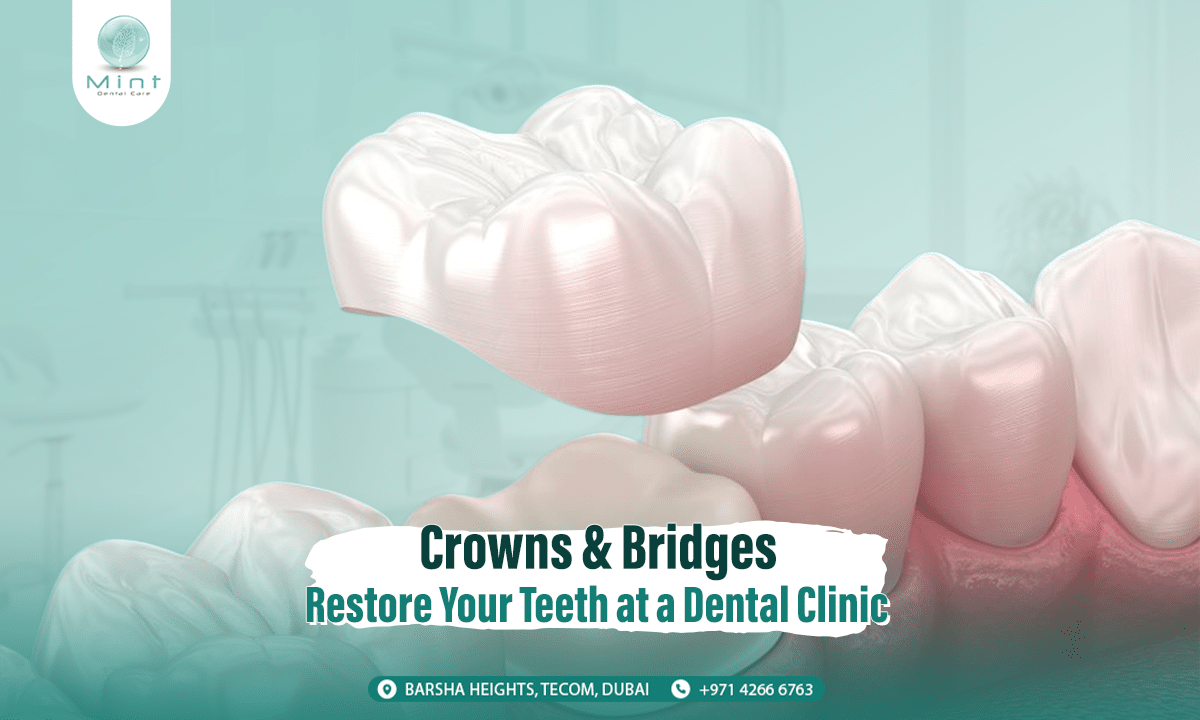
Fixed prosthetic devices called dental crowns and bridges are used to replace lost or damaged teeth, enhancing oral function, appearance, and structural integrity. While bridges fill in the space left by one or more missing teeth by attaching to nearby natural teeth or implants, crowns cover, reinforce, and shield individual damaged teeth. A dentist permanently cements both.
Dental crowns and bridges
Your dentist could advise getting artificial replacements if you are missing one or more teeth. Dentures are one type of detachable alternative that can be taken out and cleaned, but they can slide around, move, or fall out, which is obviously not to everyone’s taste.
For this reason, there are crowns attached to dental implants and bridges that work more like real teeth.
But which is the better option for you, dental crowns, bridges, or implants? We’ll examine the similarities, differences, benefits, and drawbacks of these two fixed artificial tooth alternatives so that you can have a smile that is as authentic as possible, even if you have a fake tooth or two.
- Dental Crowns: What Are They?
A dental crown procedure is a cap that is applied to a weak or injured tooth to restore missing teeth its strength, size, form, and look.
In the following situations, crowns are advised: repairing a tooth with a substantial filling and little tooth structure left, preventing a weak tooth from cracking, such as following a root canal, covering a tooth that is malformed or discolored, or providing support for a tooth bridge treatment at Mint Dentals Clinic. We give same-day crowns at our clinic using CEREC technology.
This ensures a precise fit and removes the need for several sessions by enabling us to prepare the tooth, take a digital image, and manufacture your crown all in one visit. The
- Dental bridges: what are they?
By joining an artificial tooth (or teeth) to nearby natural teeth or dental implants, a dental bridge can replace one or more lost teeth.
The gap formed by losing teeth is literally “bridged” by a bridge.
There are several kinds of bridges:
- Conventional Bridge: The most popular kind, it covers the gap’s natural teeth on both sides.
- Maryland A bonded bridge has wings made of porcelain or metal that are glued to the neighboring teeth in place of crowns.
- Cantilever Bridge: Perfect for circumstances when there is just one natural tooth on each side, it is supported by a single crown on one side.
- Implant Bridges: Fitted on dental implants instead of natural teeth; two implants are needed for support.
Dental crowns and bridges according to materials
Metals
The metal-based dental crowns and bridges prosthesis can be composed of titanium, a non-precious metal alloy (NPM), or cobalt-chromium (CoCr), an alloy with a high gold content, or a gold-reduced alloy.
However, when other metals are added, the gold-reduced alloys may result in allergies. This issue led to the development of non-precious metals (NPM) like titanium and cobalt-chromium (CoCr) as low-cost alternatives to the high-gold alloy.
Whole ceramic
Zirconium oxide, lithium disilicate, glass ceramics, and hybrid ceramics are only a few of the materials that fall under the general phrase “all ceramics.” These can be used as a monolithic (completely anatomical) crown or bridge or as a framework for veneering.
Materials for dental crowns and bridges
Dental crowns and bridges prostheses employ a wide range of materials, many of which are mixtures of precious and non-precious metals or ceramics and resins.
Because each material has unique qualities, they are frequently combined.
Because of the intense stress brought on by the chewing forces, strength is crucial even if appearance—like in the posterior region—plays a relatively little role. In certain places, complete cast bridges and crowns are utilized.
In the visible area, tooth-colored crowns and bridges—either all-ceramic crowns or so-called composite metal-ceramic crowns—are typically utilized. The dentist at Mint Dental Clinic always evaluates and clarifies. The patient is then informed about these. In addition to aesthetics, the choice of materials is influenced by the financial expenditure.
How Do Fixed Dental Prosthetics Get Put in Place?
Depending on the kind of prosthesis to be inserted, such as metal-porcelain, zirconia, e.max, or others, the teeth next to the missing tooth are first reshaped (trimmed), and their edges are somewhat reduced.
Using long-term dental glue, the prosthetic—which usually consists of three crowns (dental bridge), though occasionally two or four crowns depending on the situation and the number of lost teeth—is then affixed to the reshaped teeth.
In contrast to a dental bridge, a dental crown is applied to a single tooth without replacing neighboring lost teeth. As a result, it is increasingly frequently utilized for aesthetic reasons, as a last resort following root canal therapy, and frequently at the dentist’s recommendation.
What is the difference between dental crowns and bridges?
Dental crowns and bridges differ mostly in what they are used for. A bridge fills the space between healthy teeth or implants to replace one or more lost teeth, whereas a crown replaces a single tooth.
Since the nearby teeth serve as anchors for the repair, a bridge necessitates the preparation of several teeth. Conversely, crowns only serve to strengthen the structure and strength of the injured tooth they cover.
Bridges address the particular problem of tooth loss and the difficulties it might create, such as shifting teeth or changes in bite alignment, even though both therapies improve the look and usefulness.
The decision between a crown and a dental bridge is based on personal requirements. To suggest the best course of action, a dentist will assess variables such as the quantity of lost teeth, the state of neighboring teeth, and general oral health.
Are Fixed Dental Prosthetics Similar to Real Teeth?
Here’s why this is an excellent question:
- The treating dentist at Mint Dentals Clinic makes sure that the prosthetic’s color and shape complement the real teeth while fitting a permanent dental prosthesis.
- To prevent any dark patches from developing behind the prosthetic in the mouth, the dentist takes into account the gum line in relation to the prosthetic.
- In order to make the prosthesis as similar to actual teeth as possible, the dentist makes sure it performs flawlessly.
The dentist talks about the many materials that may be used for the prosthesis and which material is most similar to natural teeth in terms of both look and functionality.