If your braces broke right after eating nuts, do not panic. This is one of the most common ways brackets and wires get damaged during orthodontic treatment. Hard foods such as nuts are widely listed as foods to avoid with braces because they can break, loosen, or dislodge brackets and wires. Broken braces are usually not dangerous, but they can cause discomfort and may delay treatment if they are not managed properly.
At Mint Dental Care, we know this situation can feel stressful, especially if it happens at night, on the weekend, or just before an important event. The good news is that many braces problems can be managed safely at home for a short time until you are seen by your orthodontist. The key is to stay calm, protect your mouth, and know which problems can wait and which ones need urgent attention. Mint Dental Care offers orthodontic services including braces, Invisalign / clear aligners, and retainers, making it a strong local option for orthodontic care in Dubai.
Why Nuts Can Break Braces
Braces are effective, but they are also delicate. NHS orthodontic guidance explains that brackets and wires are fragile and that eating the wrong foods can break them, causing pain, discomfort, and unwanted tooth movement. That same guidance specifically lists nuts among the hard, crunchy, or sticky foods that can damage braces. The American Association of Orthodontists also includes nuts among foods that can break brackets or bend wires.
So if your braces broke after nuts, the cause is usually straightforward. The pressure from biting or chewing something hard may have loosened the glue holding a bracket to the tooth, shifted the wire, or caused a bracket to slide along the archwire.
What Might Be Broken?
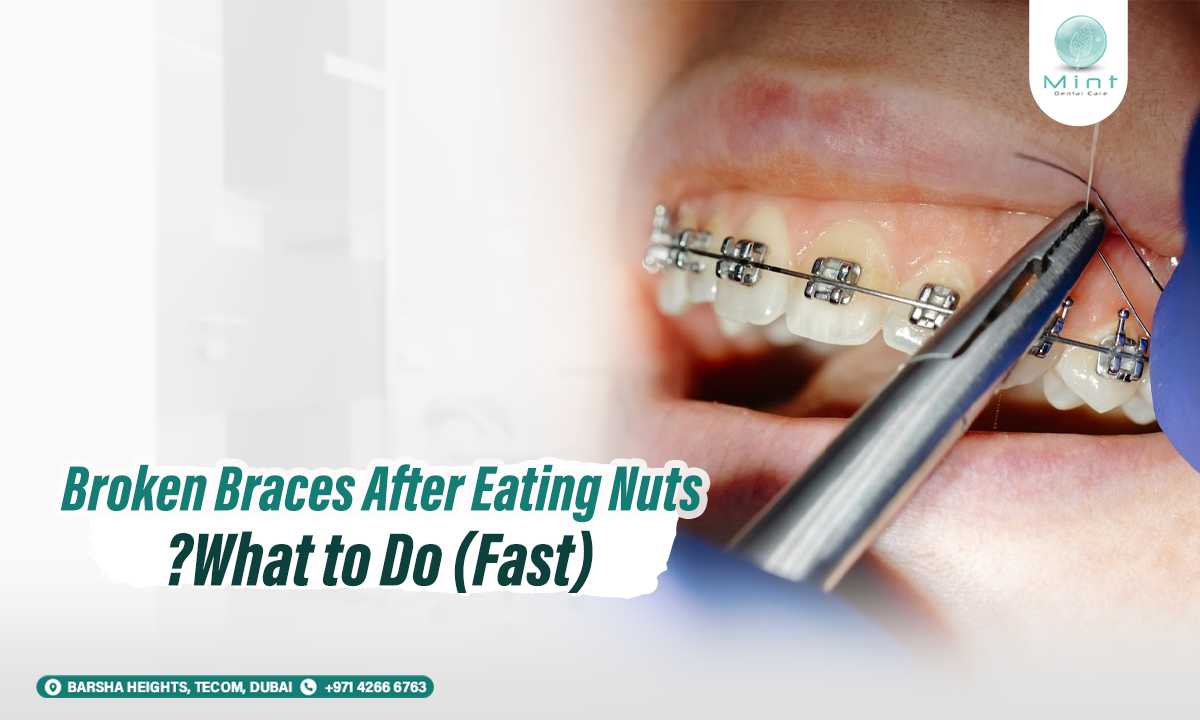
After eating nuts, the most common problems are a loose bracket, a broken bracket, or a poking wire. AAO guidance says you may notice a bracket sliding along the wire, a bracket attached to the wire but no longer bonded to the tooth, or a wire that suddenly feels long or sharp and starts irritating the cheek, lips, or tongue.
Sometimes you may also hear a small crunch or click when the bracket comes off the tooth. NHS patient guidance notes that if a bracket breaks, you may hear that sound, see that the bracket has come off the tooth, or simply feel that it is loose.
What to Do Right Away
1. Stop Eating and Check the Area Carefully
The first step is simple: stop chewing immediately. Go to a mirror with good light and look at the braces. Try to see whether the bracket is still attached to the tooth, hanging on the wire, or whether the wire itself is bent or poking. AAO guidance recommends checking your braces in a well-lit mirror so you can identify whether a bracket is loose, a wire is poking, or another appliance has moved.
Do not keep testing the tooth by biting again. More chewing can make the damage worse and may increase irritation inside your mouth. Until the brace is repaired, AAO guidance says to avoid hard, chewy, or sticky foods.
2. Do Not Pull, Twist, or Wiggle the Broken Part
Once you notice a loose bracket or bent wire, resist the urge to keep touching it. Tugging on it can make the problem worse and may injure your lips, cheeks, or gums. The AAO specifically advises patients not to pull on loose appliances and instead to contact the orthodontist for advice.
This is especially important if the part is still attached to the wire. A loose bracket that remains on the wire often looks dramatic, but that does not mean you should try to remove it yourself.
3. If the Bracket Is Still on the Wire, Gently Reposition It
If the bracket has come off the tooth but is still attached to the wire, AAO guidance says you can gently slide it back toward the center of the tooth. This can make it less irritating while you wait for professional repair. Once it is in a more comfortable position, place a small amount of orthodontic wax over it to hold it more comfortably and reduce rubbing.
If the bracket is simply loose but not causing pain, NHS guidance says that if your next appointment is within about two weeks, you may sometimes wait until that appointment to have it repaired. If your next appointment is farther away, you should contact the orthodontic department.
4. If a Wire Is Poking, Try a Safe Temporary Fix
If the problem is a sharp or loose wire, the AAO recommends trying a clean pencil eraser or cotton swab to gently push the wire toward the tooth so it lies flatter. If that does not solve the irritation, cover the end with orthodontic wax to create a smooth surface. If a very small piece of wire has broken off and you can safely remove it with clean tweezers, AAO guidance says you may do so.
The goal here is comfort, not a full repair. If you cannot safely reposition the wire, do not force it. Use wax and call your orthodontist.
5. Soothe the Mouth if It Is Irritated
If the broken brace has rubbed your cheek or tongue, choose soft foods and rinse with warm salt water. The AAO recommends soft foods such as yogurt, smoothies, pasta, or scrambled eggs for soreness and irritation, and also recommends a warm salt-water rinse plus orthodontic wax over areas that rub.
This can help you stay comfortable until the repair visit. It also reduces the chance that a sharp bracket or wire will keep scraping the same area of your mouth.
6. Contact Your Orthodontist as Soon as Possible
Even if the problem seems minor, let your orthodontist know. The AAO states that broken braces cannot deliver the right forces to move your teeth, and that this can prolong treatment. AAO emergency guidance also says urgent orthodontic problems such as loose brackets and loose wires should be reported right away.
In other words, home care is temporary. It is there to keep you comfortable, not to replace a repair appointment.
When Is It an Emergency?
Most broken brackets are urgent orthodontic problems, not true medical emergencies. But some situations do require immediate urgent care. The AAO says to seek emergency care right away if there is heavy or uncontrolled bleeding, trouble breathing or swallowing, a suspected broken jaw or major facial trauma, or if a permanent tooth is knocked out or severely displaced. It also lists sudden severe pain with facial swelling, fever, or signs of infection as reasons to seek emergency medical or dental attention.
So if your braces broke simply from nuts and you now have a loose bracket or mild poking wire, that is usually not an emergency room issue. But if the break happened along with a serious injury, severe swelling, or breathing difficulty, get urgent help first.
What Not to Do
Do not keep eating nuts, ice, popcorn, hard candy, or other hard foods once the brace is broken. AAO and NHS guidance both warn that hard foods can continue to break brackets and bend wires.
Do not try to glue the bracket back yourself. Do not bend the wire aggressively. Do not ignore it for weeks just because the pain settled down. A broken brace may stop moving the tooth correctly, and NHS guidance notes that damage to braces can lead to unwanted tooth movement and longer treatment.
Will Broken Braces Delay Treatment?
They can. The AAO is very clear that broken braces cannot deliver the right forces to move teeth and may prolong treatment. NHS guidance also says damage to braces can cause unwanted tooth movement and may make treatment take longer.
That does not mean one broken bracket always creates a major delay. But it does mean the safest approach is to report it early and get it repaired in the timeframe your orthodontist recommends.
How to Prevent This Happening Again
The biggest prevention tip is simple: avoid foods your orthodontist has told you to avoid. Nuts are on that list for a reason. NHS braces guidance says all food should be cut up small and eaten on the back teeth where possible, and that softer choices such as soup, pasta, yogurt, cheese, and soft fruits or vegetables are better during treatment. The AAO also recommends choosing braces-friendly foods and cutting harder foods into smaller pieces rather than biting directly into them.
It also helps to keep a small braces emergency kit at home or in your bag. The AAO suggests having orthodontic wax, a small mirror, and clean tweezers or small clippers available so minor issues are easier to manage until you are seen.
When to Call Mint Dental Care
If you are in Dubai and your braces break after eating nuts, call Mint Dental Care for orthodontic advice and repair planning. The clinic offers metal or ceramic braces, Invisalign / clear aligners, and retainers, and is located in Tameem House, Barsha Heights, Tecom, Dubai. Mint Dental Care lists opening hours as Monday to Saturday, 9:00 am to 9:00 pm, and Sunday, 11:00 am to 7:00 pm.
Final Thoughts
If you have broken braces after eating nuts, the smartest response is not panic. It is a calm, practical plan. Stop eating, check the brace, use wax if needed, switch to soft foods, and contact your orthodontist as soon as possible. Most loose brackets and poking wires can be managed briefly at home, but they still need professional review because broken braces can interfere with treatment and may make your orthodontic journey longer.