By providing patients with quicker, more comfortable, and more affordable treatment choices, the benefits of 3d printing in dentistry are revolutionizing the dental industry.
Our staff at Mint Dentals Clinic can now more accurately and efficiently perform orthodontics and high-quality restorations thanks to this technology. Here, we’ll examine the advantages of 3D printing for the benefits of 3d printing in dentistry.
Benefits of 3d printing in dentistry
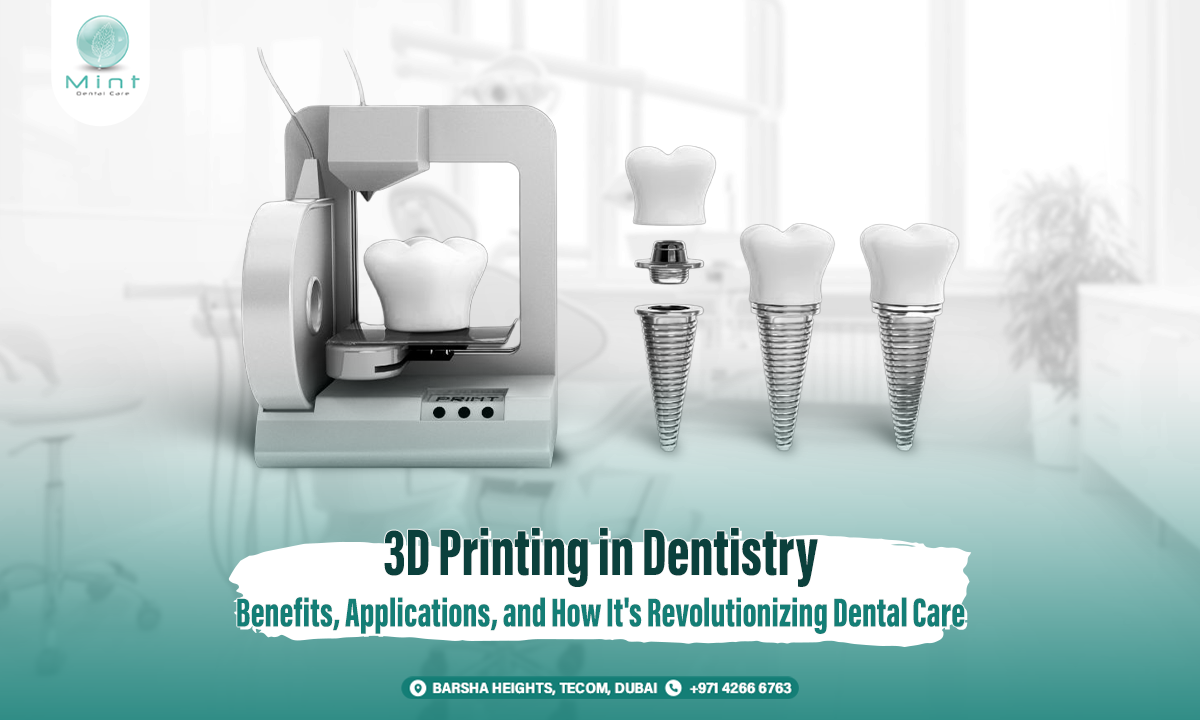
These days, a wide range of sectors employ 3D printing for a number of purposes. In recent years, there have been significant technological advancements in the dentistry and medical industries. Intraoral scanners and 3D printers are enabling dentists to use digital workflows that increase office efficiency and enhance patient results.
Dental 3D printers have historically included complicated procedures, inefficiency, and messy, uncomfortable post-processing. Because the procedure was manual, dentists or lab workers had to put in a lot of time and have specialized skills.
There is no one-size-fits-all solution for orthodontics, splints, surgical guides, and other uses, and it is sometimes necessary to make several iterations of the same mouthpiece.
3D printed dental models offer the ideal answer, enabling the rapid and economical production of custom surgical guides, splints, and implants. There is no longer a need for the time-consuming procedure of capturing physical imprints and shipping them to the laboratory.
Let’s examine the benefits of 3d printing in dentistry and major advancements that are encouraging an increasing number of dentists to use 3D printing services.
Main Benefits
The following are the main benefits of 3D printing in dentistry:
- Enhanced Speed and Efficiency: 3D printing speeds up the manufacturing of dental models, surgical guides, and clear aligners, enabling same-day patient delivery, which boosts clinic productivity.
- High Precision and Customization: By producing precisely crafted orthodontics or prosthetics that are suited to each patient’s particular anatomy, technology reduces mistakes and enhances fit, allowing for individualized care.
- Improved Patient Experience: Digital scanners and printers minimize the discomfort that comes with conventional impression materials.
- Faster appliance turnaround times, such as less than two hours, lead to higher patient satisfaction.
- Advanced Materials and Accuracy: The durability, biocompatibility, and high-detail capabilities of modern 3D printing resins enable strong and aesthetically pleasing crowns, dentures, and dental implants.
- Better Digital procedure: 3D printing facilitates a seamless, digital, and often cloud-based procedure that enhances lab collaboration by directly integrating with intraoral scanning digital dentistry technology.
- Cost-Effectiveness: When compared to conventional techniques, dental laboratories and clinics can reduce manufacturing expenses.
In digital dentistry, what does 3D printing mean?
According to the American Society of Testing and Materials, additive manufacturing, often known as 3D printing, is “the process of joining materials to make objects from 3D model data, usually layer upon layer.”
Therefore, it may be utilized for a wide range of diverse dental applications as an additive maker of three-dimensional equipment, including but not limited to:
- Examine and grin at design models
- Surgical guidelines for periodontal and implant procedures
- Night guards and bite splints
- Clear aligners
- Production of detachable prosthesis like dentures
- Personalized trays
- Temporary repairs
The most often used 3D printing methods in dentistry are selective laser sintering (SLS), material jetting (MJ), stereolithography (SLA), and fused deposition modeling (FDM). Additive manufacturing encompasses a wide range of 3D printing technologies.
Since the major 3D printing technology patents expired in 2013, the industry has witnessed exponential advancements in 3D printing technology that are now accessible to customers at ever-more-competitive pricing.
These days, a wide variety of printers, from low-cost individual printers to more sophisticated industrial printing environments, are available to satisfy the demands of various dentists and clinics.
Applications of 3D printing in dentistry
- Orthodontic Aligners: Fast, transparent aligners.
- Surgical guides: more accurate implant placement.
- Restorations: Building bridges, crowns, inlays, onlays, and an increasing number of permanent constructions.
- Splints and Dentures: For optimal comfort, use precise, custom-printed splints and dentures.
How dentistry uses 3D printing: Transforming Dental Care
Dental prosthesis, aligners, and surgical guides can now be produced quickly, precisely, and individually thanks to 3D printing, which is transforming the field. In addition to enabling same-day treatments and cutting production timelines from weeks to hours, it also lowers labor and material waste, which improves patient satisfaction and lowers costs.
Benefits of 3d printing in dentistry and important ways that 3D printing is changing dental treatment include:
- Same-Day Dentistry: In-office printers make it possible to quickly fabricate crowns, bridges, and personalized dental appliances in a single appointment, doing away with the need for painful, temporary substitutes.
- High Precision & Personalization: CAD software and digital intraoral scans are used to create dental devices, which guarantee a precise fit that corresponds to each patient’s distinct anatomy and greatly minimizes the need for manual modifications.
- Improved Treatment Planning: For implantology, for instance, the technology offers high-accuracy surgical guides that enable better placement, greater success rates, and less invasive operations.
- Wider Range of Uses: Dentures, clear aligners, retainers, nightguards, and instructional models are just a few of the many products that 3D printing is now used for.
- Decreased Costs: 3D printing decreases the overall cost of production for prostheses by increasing workflow efficiency and reducing manpower needs.
- Improved Patient Experience: Contactless 3D scanning and the possibility of receiving restorations or appliances in a single, shorter visit reduce patients’ worry and pain.
These developments are mostly due to methods like fused deposition modeling (FDM), digital light processing (DLP), and stereolithography (SLA).
Conclusion about the Benefits of 3d printing in dentistry
Advances in 3D printing are making it possible for an increasing number of dental clinics to use them and take advantage of digital processes. Increased production, cost and time savings, and an enhanced patient experience are all benefits of 3d printing in dentistry.
Compared to dentists who don’t keep up with technological advancements, those who make the switch to digital dentistry will be able to provide a competitive service and draw in or maintain more people, like Mint Dentals Clinic.
Why hold off on achieving perfection?
At Mint Dentals Clinic, take advantage of 3D printing for quicker, more precise dental treatments.
Make an appointment right now to begin your ideal smile!