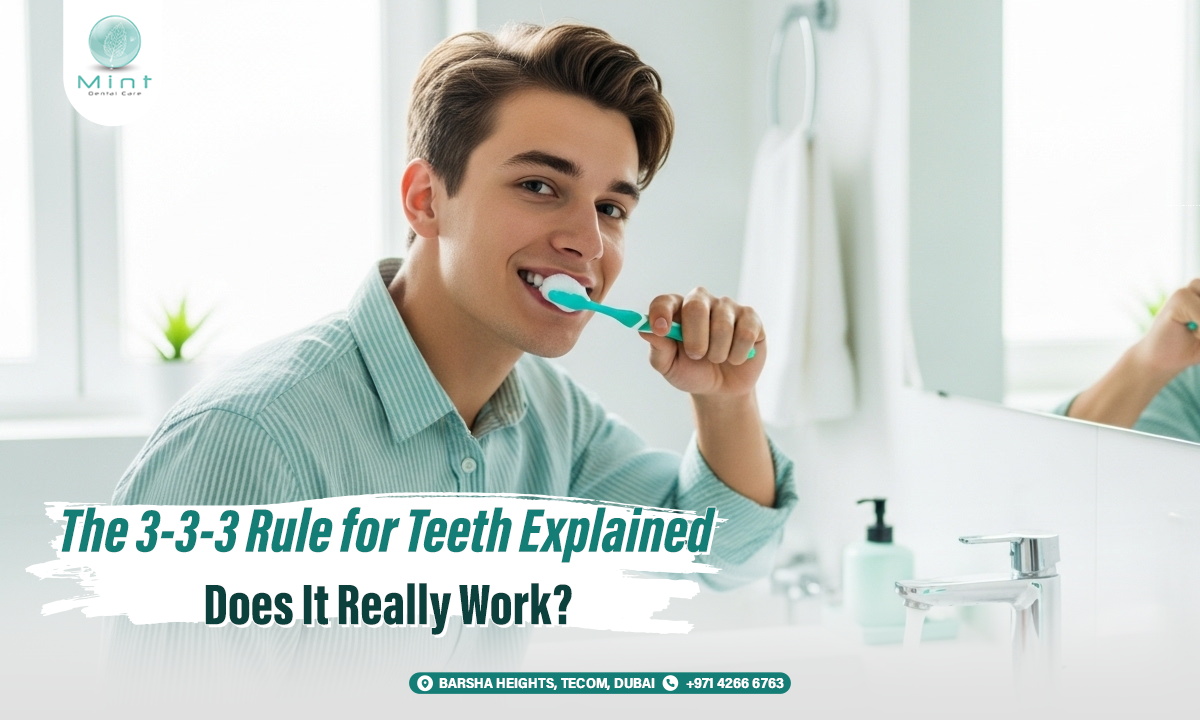
If you have been scrolling through oral health tips online, you may have seen people talking about the 3-3-3 rule for teeth. It sounds simple, memorable, and easy to follow, which is exactly why it has become so popular. But is it actually a smart dental habit, or just another catchy wellness rule that sounds better than it works?
At Mint Dental Care, we believe oral health advice should be practical, evidence-based, and realistic for everyday life in Dubai. The truth is that the 3-3-3 rule for teeth is not completely wrong, but it is not a perfect rule either. Some parts of it can support better oral hygiene. Other parts can be misleading if they are followed too literally, especially after acidic foods and drinks.
In oral-hygiene discussions, the Korean 3-3-3 rule is generally described as brushing 3 times a day, within 3 minutes after a meal, and for at least 3 minutes each time. A 2017 Korean population study described it exactly this way and noted that it had been promoted in Korea through a Korean Dental Association campaign.
So, does it really work? The short answer is: partly yes, but not exactly as a universal rule. To understand why, it helps to break down each “3” and compare it with what major dental guidance actually recommends. The American Dental Association recommends brushing twice a day for two minutes with fluoride toothpaste and cleaning between the teeth daily, while NHS guidance similarly advises brushing twice a day for about two minutes with fluoride toothpaste.
What Is the 3-3-3 Rule for Teeth?
The most common version of the rule means three things. First, you brush three times per day. Second, you brush within three minutes after eating. Third, you brush for three minutes each time. This version is often linked to Korean oral-health culture and has been discussed as a structured brushing habit rather than as a formal global guideline. The Korean study describing the campaign also found that brushing after lunch and before bedtime was associated with lower odds of periodontitis in the surveyed population, although the authors clearly stated that the study was cross-sectional and could not prove causation.
That distinction matters. A rule can be a useful routine without being the official gold standard for everyone. At Mint Dental Care, this is how we look at it: if a habit helps a patient brush more consistently, remove more plaque, and stay aware of oral hygiene, that can be positive. But a memorable rule should never replace proper dental judgment, especially when timing, technique, enamel protection, and fluoride use matter more than catchy numbers.
Does Brushing Three Times a Day Help?
For some people, yes. Brushing more often can help disrupt plaque more frequently during the day. The Korean study found that certain brushing behaviors, including brushing after lunch and before bedtime, were associated with lower odds of periodontitis in Korean adults. It also reported that brushing three times or more per day was less common in the periodontitis group than in the group without periodontitis. However, the same paper emphasized that its design could not establish cause and effect.
That means we should be careful with the takeaway. The study suggests that more frequent brushing may be part of a healthier oral-care pattern, but it does not prove that everyone must brush three times daily to have healthy teeth and gums. Major dental guidance still centers on twice-daily brushing as the evidence-based baseline. The ADA says to brush twice daily for two minutes with fluoride toothpaste and clean between teeth daily, and the NHS gives nearly the same advice.
So is brushing three times a day harmful? Not necessarily. In many cases, an extra midday brush can be a helpful bonus. But it is a bonus, not a strict requirement, and it must be done gently with the right timing. Technique matters just as much as frequency.
Is Brushing Within Three Minutes After Eating a Good Idea?
This is the part of the rule that needs the most caution. Brushing immediately after every meal is not always ideal, especially after acidic foods or drinks. Mayo Clinic advises not to brush right after consuming acidic foods or beverages because acid can temporarily soften enamel, and brushing too soon can wear that softened surface away. Mayo Clinic recommends waiting about one hour after acidic exposure before brushing.
This is important because many common foods and drinks are acidic, including citrus fruits, juices, soft drinks, sports drinks, and sour candies. If someone follows the 3-3-3 rule too literally and brushes within three minutes after acidic meals, they may actually increase enamel wear over time. That is one reason why the “within three minutes” part cannot be treated as a universal rule for everyone.
A better approach is this: if your meal was not acidic and brushing is convenient, a gentle post-meal brush may be fine. But if you had an acidic breakfast, orange juice, soda, lemon water, vinegar-heavy foods, or anything that leaves your mouth feeling acidic, it is smarter to wait and let saliva help neutralize the acids first.
Do You Really Need to Brush for Three Minutes?
Not usually. Official guidance from the ADA and NHS recommends two minutes, not three, for routine brushing. Two minutes done properly with fluoride toothpaste is the standard target for most adults and children old enough to brush independently.
That does not mean three minutes is automatically too long. Some people, especially those with braces or very crowded teeth, may naturally spend a little longer brushing. But more time is only useful if the brushing is gentle and thorough. A longer session with poor technique, too much pressure, or a hard-bristled brush is not better dentistry. In practical terms, many patients are better off improving coverage and gentleness rather than chasing an exact three-minute timer. The evidence-based minimum remains two minutes with fluoride toothpaste.
So Why Has the 3-3-3 Rule Become Popular?
Because it is easy to remember, and simple routines are more likely to stick. That is one of the real strengths of the rule. It gives people a clear structure: after meals, think about your teeth; during the day, don’t rely only on nighttime brushing; and spend enough time to clean properly. Those are useful behavioral reminders.
The Korean study also helps explain why the rule gained attention. It specifically identified the Korean 3-3-3 brushing campaign and found associations between certain brushing habits and better periodontal outcomes in a large national sample. Even though that does not prove the rule itself is the reason, it does show why the routine has remained influential.
From a dental perspective, the rule works best as a habit cue, not as a rigid law. It reminds people to brush often enough, not rush through it, and think about oral hygiene during the day. But once the rule starts conflicting with enamel safety or becomes stressful to maintain, it stops being helpful and starts becoming oversimplified.
What Do Dentists Actually Recommend Instead?
At Mint Dental Care, we would simplify the message this way: brush twice a day for two minutes with fluoride toothpaste, clean between the teeth daily, and add an extra daytime brush when it makes sense for your schedule and your mouth. That approach matches current ADA and NHS guidance far better than blindly following the 3-3-3 formula.
The most important non-negotiables are consistency and fluoride. The ADA’s home-care recommendations emphasize twice-daily brushing with fluoride toothpaste and daily interdental cleaning. The NHS likewise stresses fluoride toothpaste and a two-minute routine. In other words, you will usually gain more from using the right toothpaste and brushing properly every day than from turning brushing into a perfect numbers game.
A Better Version of the 3-3-3 Rule
If you like the idea of a memorable framework, there is a smarter way to interpret it. Think of it like this: try to protect your teeth throughout the day, especially after meals, but do not rush to brush immediately after acidic foods. Focus on good-quality brushing, not aggressive brushing. And remember that three times a day can be helpful, but two good brushes a day are the professional standard for most people.
That kind of flexible approach is much more realistic. It respects both the useful part of the Korean habit and the enamel-protection advice from major dental authorities. It also fits real life better for working adults, students, parents, and patients with different oral-health needs.
When an Extra Midday Brush Can Be Helpful
A midday brush can be particularly useful for people who feel food sits on their teeth during the day, or for those who simply know they brush poorly at night when tired. It can also be a useful cleanliness habit if done gently and with proper timing. But again, “helpful” is not the same as “mandatory.” The official baseline remains twice daily.
For some patients, a water rinse after meals, sugar-free gum, or simply waiting until the mouth no longer feels acidic may be a better immediate step than rushing to brush. The key is to protect enamel while still managing plaque and food debris sensibly. Mayo Clinic’s guidance on waiting after acidic foods is the clearest reason this matters.
What Mint Dental Care Recommends
Mint Dental Care’s services include routine checkups, cleanings and exams, fluoride treatments, pediatric dentistry, braces, Invisalign / clear aligners, and general dentistry, which means our team looks at oral hygiene as part of a full preventive-care plan rather than as an isolated brushing rule. The clinic also emphasizes patient comfort, prevention, and tailored treatment options.
That is why our advice is never just “brush more.” It is “brush correctly, use fluoride toothpaste, protect your enamel, clean between your teeth, and come in for regular assessments.” A patient with sensitivity, erosion, gum inflammation, or orthodontic appliances may need a customized routine, not a viral rule copied from social media.
Final Verdict: Does the 3-3-3 Rule Really Work?
Yes, the 3-3-3 rule for teeth can work as a motivational habit, especially if it helps someone brush more consistently and pay more attention to oral hygiene during the day. The Korean research behind the rule found associations between certain brushing habits and lower odds of periodontitis, which helps explain why the rule remains popular. But it is not the same as official universal guidance, and the “within three minutes after eating” part can be a problem after acidic meals and drinks.
For most patients, the best evidence-based foundation is still very clear: brush twice a day for two minutes with fluoride toothpaste, clean between your teeth daily, and be careful not to brush too soon after acidic foods or drinks. If you want to add a third daily brushing session, that can be helpful, but it should be done thoughtfully rather than automatically.
Book a Preventive Checkup at Mint Dental Care
If you are unsure whether your brushing routine is helping or harming your teeth, a professional dental assessment is the best next step. At Mint Dental Care, we provide preventive checkups, cleanings, fluoride treatments, orthodontic care, and general dentistry in a modern patient-focused clinic in Dubai.
Book your appointment with Mint Dental Care and let our team help you build an oral-care routine that is not just trendy, but actually right for your teeth.